Product guide · RunSustainably module · Updated 24 September 2026
How do you assess financial materiality for AASB S2?
A financial materiality assessment for AASB S2 is the process of working out which climate-related risks and opportunities could reasonably be expected to affect your cash flows, access to finance or cost of capital. It matters because AASB S2 requires you to disclose those risks and opportunities, and the process you used to assess them. Drova helps by recording each risk and opportunity with its score, rationale and evidence in RunSustainably, the sustainability and materiality module of Drova's RunGood platform.
Short answer
A financial materiality assessment for AASB S2 identifies the climate-related risks and opportunities that could reasonably be expected to affect your cash flows, access to finance or cost of capital over the short, medium and long term. You list the climate issues relevant to your business, score each risk on likelihood and consequence, record the rationale and evidence, and treat anything above your threshold as material for disclosure.
Under AASB S2, information is material if omitting, misstating or obscuring it could reasonably be expected to influence the decisions of the primary users of your report: existing and potential investors, lenders and other creditors.
- The direction of the test. Financial materiality looks at how the outside world, including climate, affects your business and its finances. Impact materiality looks the other way, at how your business affects people and the environment.
- Short, medium and long term. AASB S2 asks you to say which time horizon each risk or opportunity falls in, how you define the three horizons and how those definitions link to your planning.
- Rationale on every score. A score without a written rationale and a source will not stand up when the assessment is assured.
Note
Before you start
This guide is for the person preparing or reviewing the AASB S2 disclosure: a sustainability lead, a finance lead or a risk manager. Have last year's financial report, your risk matrix and your current climate issue list to hand.
If you want a view of your overall AASB S2 readiness first, take the ASRS readiness assessment. The other AASB S2 product guides are listed in the Drova help hub. Account help, sign-in and security settings are covered in the Drova help centre, not here.
How do you run the assessment?
- Pick the climate issues that apply. Start from a recognised issue list for your industry, then add the physical risks (floods, heat, storms) and transition risks (carbon pricing, customer expectations, technology shifts) that touch your operations, suppliers and customers. AASB S2 asks you to say whether each risk is a physical risk or a transition risk.
- Describe each risk and the opportunity beside it. One line each: what happens, to which part of the business, over which time horizon. Write the opportunity too, because AASB S2 asks for both.
- Score likelihood and consequence. Use the same scale your risk register already uses so the result is comparable. Consequence means the effect on revenue, costs, assets, financing or cost of capital, not reputation alone.
- Set the threshold and record the rationale. Decide in advance which score counts as material, apply it without exception, and write the reasoning and the evidence for every score. Assurance over climate statements phases in under the AUASB's ASSA 5010, so that written trail is what an assurance practitioner will ask to see.
- Take the material items into strategy and the register. Material climate risks feed the strategy pillar (scenario analysis, transition planning) and belong in your enterprise risk register with an owner and controls.
- Review annually, or when the business changes. A new site, a new supplier region or a new regulation changes the answer. Date the assessment and keep the previous version.
What the regulator requires
AASB S2 Climate-related Disclosures is the Australian Sustainability Reporting Standard that sets out what a reporting entity must disclose about climate-related risks and opportunities. It is based on IFRS S2, issued by the International Sustainability Standards Board (ISSB) in June 2023.
AASB S2 requires you to disclose the climate-related risks and opportunities that could reasonably be expected to affect your prospects, and to explain the processes you use to identify, assess, prioritise and monitor them. That process description is a required disclosure in its own right under the risk management pillar.
Reporting is phased under the Corporations Act 2001: Group 1 from annual periods beginning on or after 1 January 2025, Group 2 from 1 July 2026 and Group 3 from 1 July 2027, with the thresholds set out in ASIC Regulatory Guide 280. Work out your group on the applicability page.
A Group 3 entity that concludes it has no material climate-related financial risks or opportunities may lodge a statement to that effect under section 296B of the Corporations Act instead of full disclosures, together with a statement explaining how it reached that conclusion (RG 280, paragraph 74). The assessment still has to be done, and documented, to reach that conclusion.
The full list of what you will disclose, clause by clause, is in the AASB S2 disclosures checklist.
In Drova
Start from your issue list
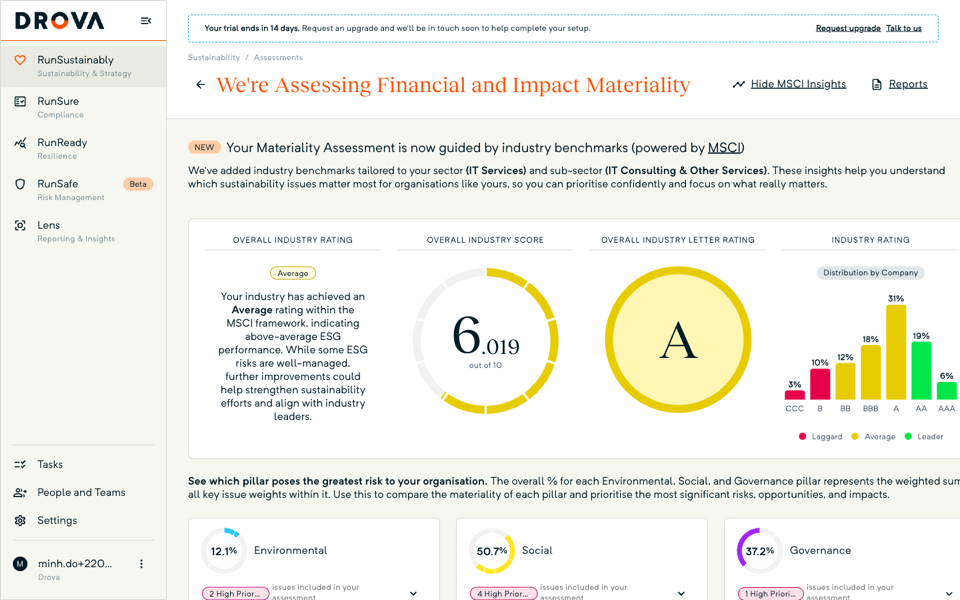
Open RunSustainably, then Assessments. Drova seeds a Potential ESG issues list from your industry and sub-industry, with MSCI industry benchmarks above the list showing which issues are rated high and moderate priority for organisations like yours. Use Add ESG Issue to bring in a climate issue from the library, and pick AASB S2 in the framework list so the issue is tagged for this standard. Remove anything that does not apply to you.
The ways to build the list, from benchmarks, the library or your own wording, are covered in how to add climate issues to your materiality assessment.
In Drova
Add the risks and score them
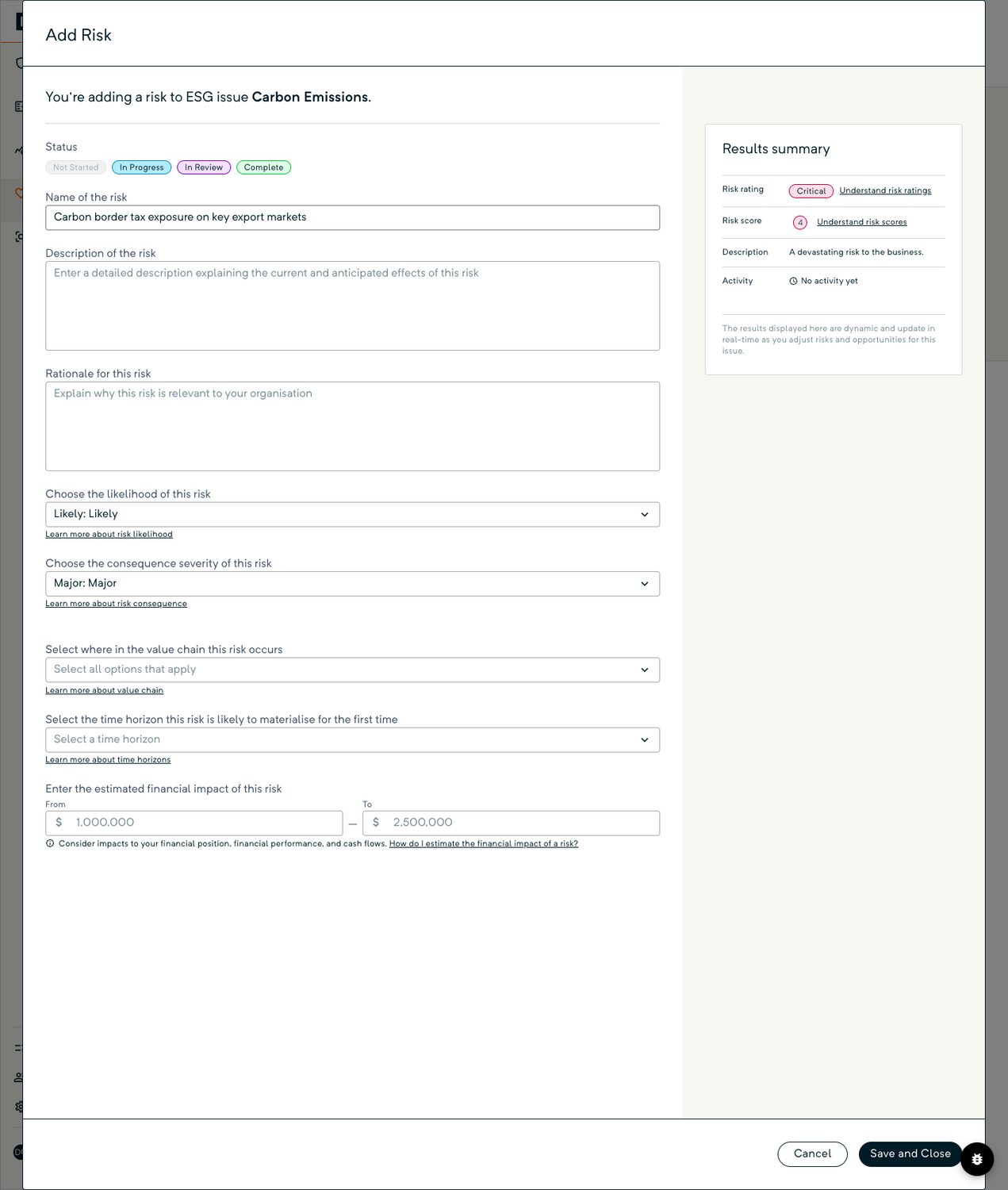
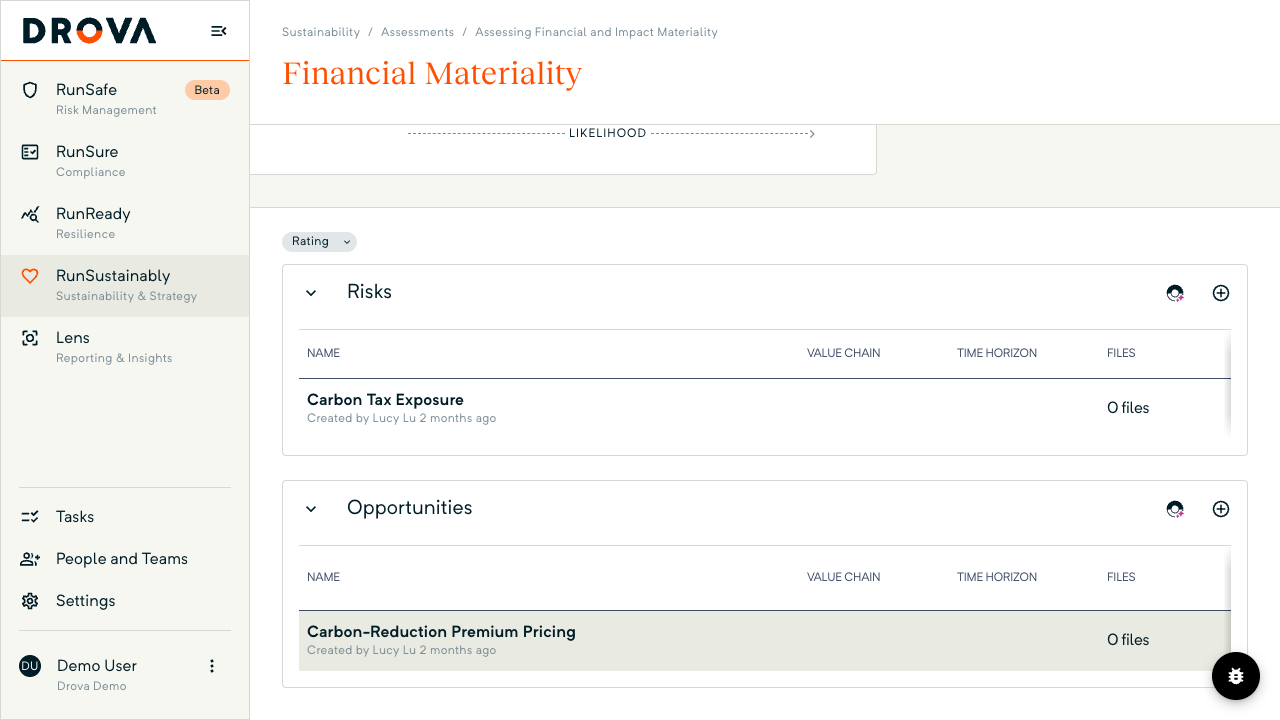
Open Financial Materiality on the climate issue. Choose Add Risks with Sheila to have Sheila, Drova's AI assistant, draft candidate risks from your issue and industry, or Add My Own Risk to write one yourself. Each risk is scored on a 5 by 5 likelihood and consequence matrix, with fields for Rationale, Value Chain, Time Horizon and an estimated financial impact, and supporting files can be attached to the risk. Sheila drafts; your team decides the score.
The review step for Sheila's drafts is in how to use Sheila to identify climate risks for AASB S2, the upside beside each risk is in how to assess climate-related opportunities for AASB S2, and where the attached files end up for assurance is in how to build an evidence trail for AASB S2 assurance.
In Drova
Complete the assessment and read the result
Set each scored risk and opportunity to Complete; only Complete items count towards the verdict. A risk rated significant or critical, or an opportunity rated medium or high, returns a Material verdict for the issue. The Overview tab plots each assessed issue on the materiality matrix.
Under Reports, export the Materiality Assessment Result spreadsheet for your assurance file, or generate the Compass - Materiality Assessment Quality report, an AI-assisted quality check that lands in Reporting. The matrix and counters are explained in how to read your materiality matrix and results, and the export in how to export materiality results for your auditors.
Tip
Worked example
A Group 2 grocery retailer with 60 stores and a chilled supply chain lists three climate issues: extreme heat, flood exposure at two distribution centres, and a possible carbon price on refrigerant gases. The heat risk scores likely and major over the medium term, because cold-chain failures hit revenue directly. The flood risk scores almost certain and moderate over the long term. The refrigerant risk scores possible and moderate over the short term.
The first two clear the threshold and are marked material; the third is recorded, dated and left below the line with its rationale. Both material risks are then added to the enterprise risk register with an owner, as described in how to add climate risks to your risk register. Figures are illustrative. How Drova supports the rest of the AASB S2 work is on the AASB S2 solution page.
Product guide. Steps and screenshots come from Drova product captures on a demo tenant, checked against the product atlas on 24 September 2026. Not yet reviewed by Customer Success; if a label or step differs from what you see in Drova, use the feedback below.
Frequently asked questions
What is the difference between financial materiality and impact materiality?
Financial materiality looks at how climate affects your business and its finances. Impact materiality looks at how your business affects people and the environment. AASB S2 requires the financial view only; European CSRD reporting requires both.
Does AASB S2 require a specific scoring method?
No. AASB S2 requires you to disclose the processes you use to identify, assess, prioritise and monitor climate-related risks, and to apply the standard's definition of material information. A likelihood and consequence matrix with a written rationale for every score meets that bar if you apply it consistently.
Which time horizons should I use?
AASB S2 asks you to define short, medium and long term for your business and to explain how those definitions link to your strategic planning horizons. A common approach is to align the medium term with your planning cycle and the long term with the life of your major assets.
Do I have to assess opportunities as well as risks?
Yes. AASB S2 covers climate-related risks and opportunities, so record the opportunity beside each risk where one exists, such as lower energy costs from electrification. In Drova, opportunities are scored on a single degree-of-opportunity scale rather than the risk matrix.
Is a financial materiality assessment the same as a risk register entry?
No. The materiality assessment decides whether a climate issue is material for disclosure. The risk register manages a risk day to day, with an owner, appetite and controls. In Drova the assessment lives in RunSustainably and the register lives in RunSafe, so a material climate risk is added to the register as a separate step.
What if the assessment finds nothing material?
Document how you reached that conclusion. A Group 3 entity may lodge a statement under section 296B of the Corporations Act that it has no material climate-related financial risks or opportunities, with an explanation of how it decided that, instead of full disclosures. Group 1 and Group 2 entities still report against the standard.
Was this article helpful?
Related articles
- Drova help articles
Every product guide, grouped by stage.
- How do you add climate issues to your materiality assessment?
Start from industry benchmarks, the issue library or your own wording.
- How do you use Sheila to identify climate risks for AASB S2?
Let Sheila draft candidate risks; your team scores and keeps them.
- How do you assess climate-related opportunities for AASB S2?
AASB S2 covers the upside too. Score opportunities beside the risks.
- How do you read your materiality matrix and results?
What the matrix, the counters and the Material verdict mean.
Still stuck? Contact support.
