Product guide · RunSustainably module · Updated 25 September 2026
How do you assess climate-related opportunities for AASB S2?
A climate-related opportunity is a potential positive financial effect of climate change, or of the response to it, on your business. It matters because AASB S2 requires climate-related opportunities to be assessed and disclosed beside the risks where they are material. Drova helps by recording, rating and marking each opportunity material in RunSustainably, the sustainability and materiality module of Drova's RunGood platform. This guide walks through how to identify and rate an opportunity, then shows the steps in Drova.
Short answer
A climate-related opportunity is a specific way that managing a climate issue well could benefit your business financially: lower running costs from electrification, premium pricing on low-emission products, or cheaper capital through green lending. You assess an opportunity with the same discipline as a risk: describe it, say where it sits in your value chain and when it is likely to arrive, rate how much of the business it could change, and write down why.
An opportunity that clears your materiality threshold belongs in the report beside the risks, because AASB S2 covers both.
- Upside with a cause. An opportunity is a financial benefit you can trace to a decision or a market shift, not a positive sentence about your climate commitments.
- One question, not a matrix. Opportunities are rated on how much of the business they could change, not on likelihood times consequence.
- Same threshold, same rigour. Decide in advance which rating counts as material, apply that threshold to every opportunity, and keep the rationale with the score.
Note
Before you start
Before you start, have your climate risk list, your strategy or transition plan, and any energy, financing or customer data you can cite to hand. This guide is for the person preparing or reviewing the AASB S2 disclosure: a sustainability lead, a finance lead or a risk manager. It does not cover scenario analysis or impact materiality.
If you have not yet confirmed which reporting group you fall into or how far along your AASB S2 preparation is, take the ASRS readiness assessment first. Account help, sign-in and security settings are covered in the Drova help centre, not here.
How do you assess a climate-related opportunity?
- Start from the risks you have already listed. Most climate opportunities are the other side of a risk: a carbon price is a cost risk and a pricing opportunity for lower-emission products. Walk the climate risks you assessed for financial materiality and ask what the upside is if you manage each one well.
- Add the opportunities that stand alone. Some upside has no matching risk: sustainability-linked finance, grants for electrification, or customer contracts that ask for a disclosed emissions figure. List those opportunities separately.
- Describe each one as a cause and an effect. Not "energy transition" but "replacing the diesel fleet with electric vehicles over the next fleet cycle cuts fuel and maintenance costs across the delivery network". Name the part of the business that benefits.
- Rate the size of the upside. Ask one question: how much of the business could this opportunity change if it were realised? A small but meaningful portion, a key area, or a major aspect of the whole business. Use the same scale for every opportunity.
- Set the time horizon and write the rationale. Use the same short, medium and long term definitions as your risks, because AASB S2 asks you to define those horizons and link them to your planning. The rationale says why the opportunity applies to you and why you rated it as you did. An assurance provider reads the rationale first, so treat it as part of your evidence trail.
- Apply the threshold and take material items into strategy. Decide which rating counts as material before you rate anything, and apply that threshold without exception. Material opportunities are disclosed beside the risks under the strategy pillar.
What the regulator requires
AASB S2 is the Australian Sustainability Reporting Standard for climate-related financial disclosures, made by the Australian Accounting Standards Board under the Corporations Act 2001. AASB S2 defines climate-related opportunities as the potential positive effects arising from climate change for an entity, and it covers opportunities as well as risks.
The standard requires you to disclose the climate-related risks and opportunities that could reasonably be expected to affect your prospects, to state the time horizons over which each could occur, and to describe the processes you use to identify, assess, prioritise and monitor them, including how those processes are integrated into your overall risk management.
Financial materiality under AASB S2 uses the same test as financial reporting: information is material if omitting, misstating or obscuring it could reasonably be expected to influence the decisions of the primary users of your report.
Reporting is phased under the Corporations Act 2001: Group 1 from annual reporting periods beginning on or after 1 January 2025, Group 2 from 1 July 2026 and Group 3 from 1 July 2027, with the size thresholds for each group summarised in ASIC Regulatory Guide 280. Work out your group on the applicability page. Every disclosure, clause by clause, is on the AASB S2 disclosures checklist.
In Drova
Add the opportunity to the climate issue
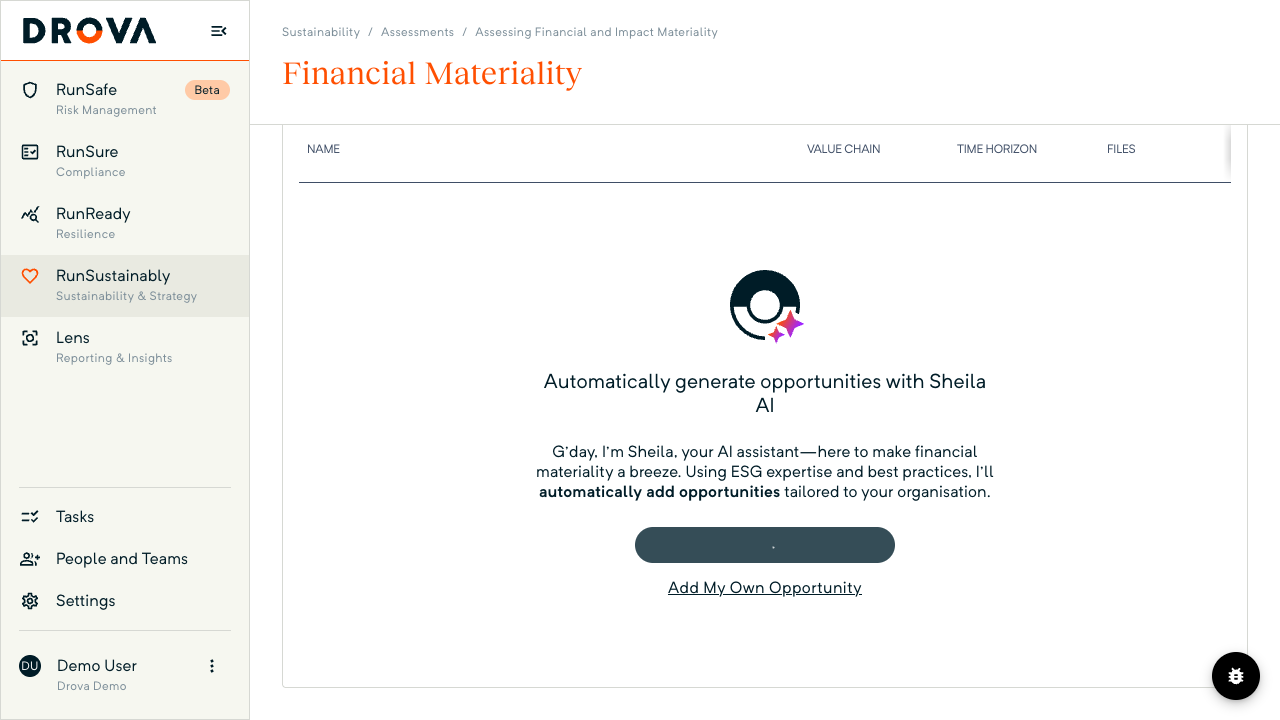
Open RunSustainably, then Assessments, and open Financial Materiality on the climate issue. The Opportunities section sits below Risks on the same page and is empty until you add something.
Choose Add Opportunities with Sheila to have Sheila draft candidate opportunities for the issue, or Add My Own Opportunity to write one yourself. Sheila's drafts land as rows marked Created by Sheila AI, with the name, description and rationale filled in and the degree, value chain and time horizon left for your team to set. Open a row to review or edit the draft, and remove any that do not apply to your business. The Sheila path mirrors the one for identifying climate risks on the Risks side of the page.
In Drova
Score the opportunity and say where it sits
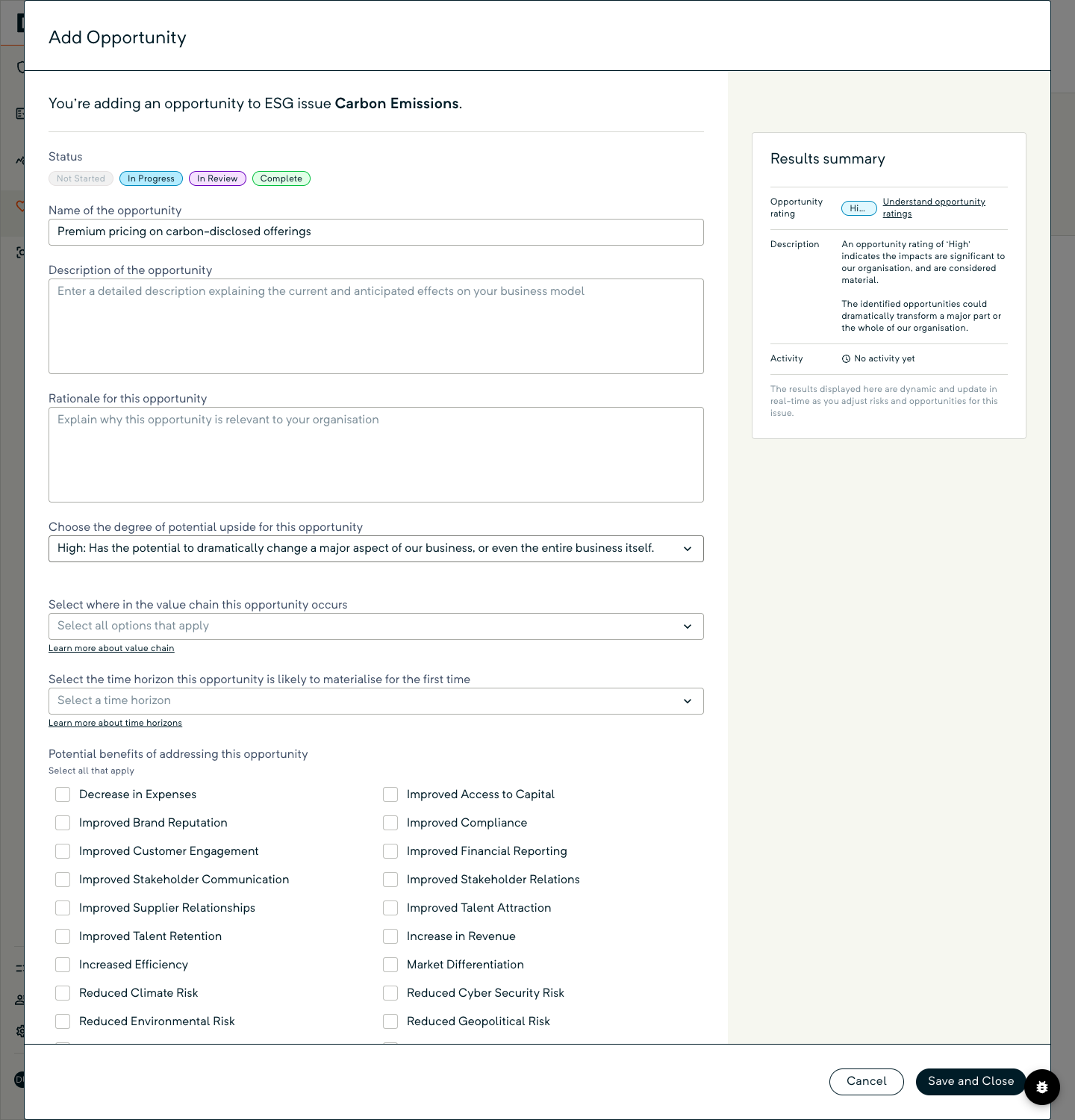
Click a row to open Edit Opportunity; an opportunity you write yourself opens as Add Opportunity with the same fields. Fill Name of the opportunity, Description of the opportunity and Rationale for this opportunity.
Then answer Choose the degree of potential upside for this opportunity with Very Low, Low, Medium or High. That degree is the rating; there is no matrix. Under Select where in the value chain this opportunity occurs pick one or more of Upstream, Company Operations and Downstream, choose the time horizon, and tick the Potential benefits of addressing this opportunity, such as Decrease in Expenses or Improved Access to Capital. An estimated financial impact range and Files are optional and do not change the rating.
In Drova
Mark it complete and read the verdict
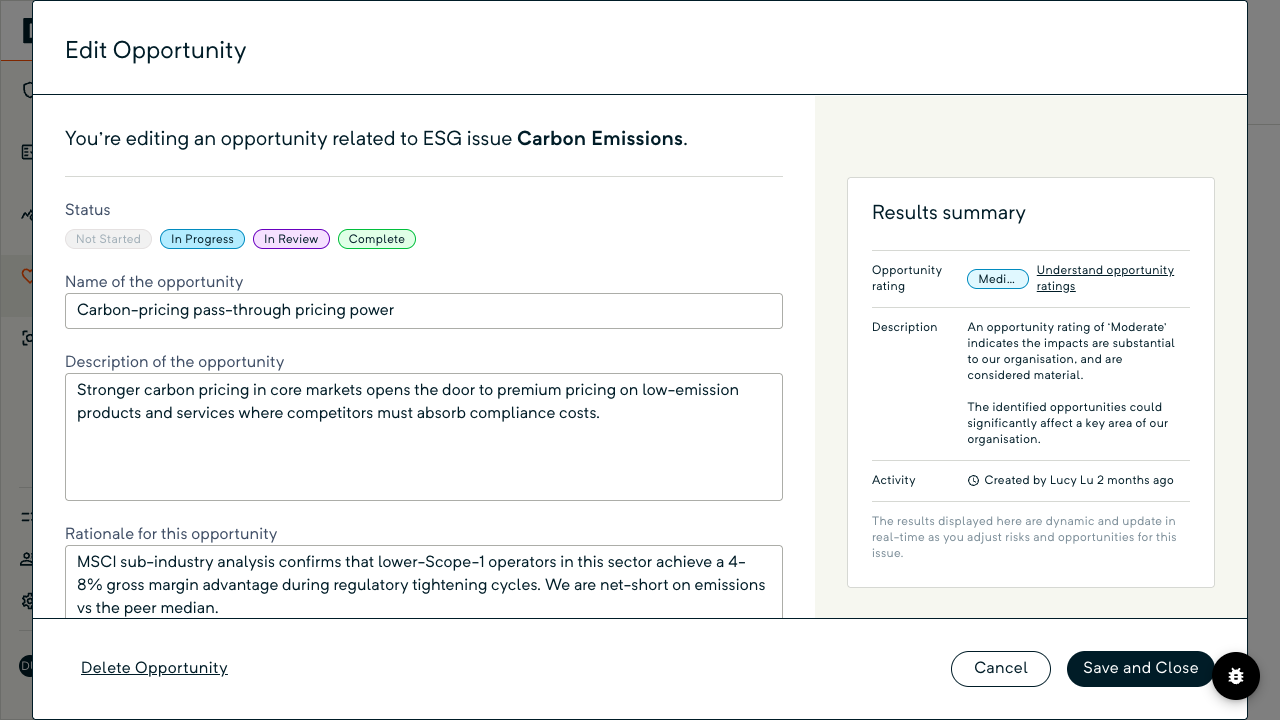
The Results summary card on the right of the dialog shows the Opportunity rating as soon as the degree is set; a Medium degree is described in the card's wording as Moderate. Set the status to Complete, which unlocks once the degree is set (In Review is an optional checkpoint), then choose Save and Close.
Only completed opportunities count. A completed opportunity rated Medium or High makes the issue Material under Determine materiality on the Financial Materiality page, the same way a significant or critical risk does; Very Low and Low do not. Any later edit drops the status back to In Progress, so mark the opportunity complete again after changes. What the verdict and the ratings mean once risks and opportunities are complete is covered in reading your materiality matrix and results.
Tip
Worked example
A Group 2 regional freight operator running a diesel fleet lists three climate opportunities against its carbon emissions issue. The first is electrifying its metropolitan routes: lower fuel and maintenance costs over the medium term, rated medium because electrification changes a key area of the business but not the whole of it.
The second is a sustainability-linked loan whose interest margin steps down as fleet emissions fall: improved access to capital, short term, rated low. The third is a low-emission delivery service for retail customers preparing their own AASB S2 reports: new revenue and market differentiation, long term, rated high.
The first and third clear the threshold and are marked complete and material, with the rationale citing the fleet plan and customer tenders. The loan is recorded, rated and left below the line. Ratings and details are illustrative. How the opportunity assessment fits the rest of the AASB S2 work in Drova is on the AASB S2 solution page.
Product guide. Steps and screenshots come from Drova product captures on a demo tenant, checked against the product atlas on 25 September 2026. Not yet reviewed by Customer Success; if a label or step differs from what you see in Drova, use the feedback below.
Frequently asked questions
What counts as a climate-related opportunity under AASB S2?
A climate-related opportunity is a way that climate change, or the response to it, could benefit your business financially: lower costs, new revenue, better access to capital or a stronger market position. AASB S2 requires both risks and opportunities to be assessed and disclosed where material.
Do I have to disclose opportunities if I have only found risks?
You have to assess opportunities even if you found only risks. If you looked and found nothing material, keep the record of how you looked, because AASB S2 asks you to describe the process you used to identify and assess opportunities.
Why are opportunities rated on a single scale rather than a matrix?
A risk is scored on likelihood and consequence because a bad outcome may or may not happen. An opportunity is rated on how much of the business it could change, from very low to high, which is the question a board asks about upside.
Which time horizons should I use for opportunities?
Use the same short, medium and long term definitions for opportunities as for your risks. AASB S2 asks you to define those horizons and explain how they link to your strategic planning, and the disclosure reads better when risks and opportunities share one clock.
Do opportunities go into the risk register?
No. The enterprise risk register in RunSafe holds risks only. Material opportunities feed your strategy and transition planning, and the Financial Materiality page in RunSustainably keeps the assessed record.
Was this article helpful?
Related articles
- Drova help articles
Every product guide, grouped by stage.
- How do you assess financial materiality for AASB S2?
The risk side of the same assessment, scored on likelihood and consequence.
- How do you read your materiality matrix and results?
What the verdict and ratings mean once risks and opportunities are complete.
- How do you use Sheila to identify climate risks for AASB S2?
The same Sheila path on the Risks side of the page.
- How do you generate an AASB S2 disclosure report in Drova?
From an active framework to a downloadable disclosure.
Still stuck? Contact support.
